

Product Description
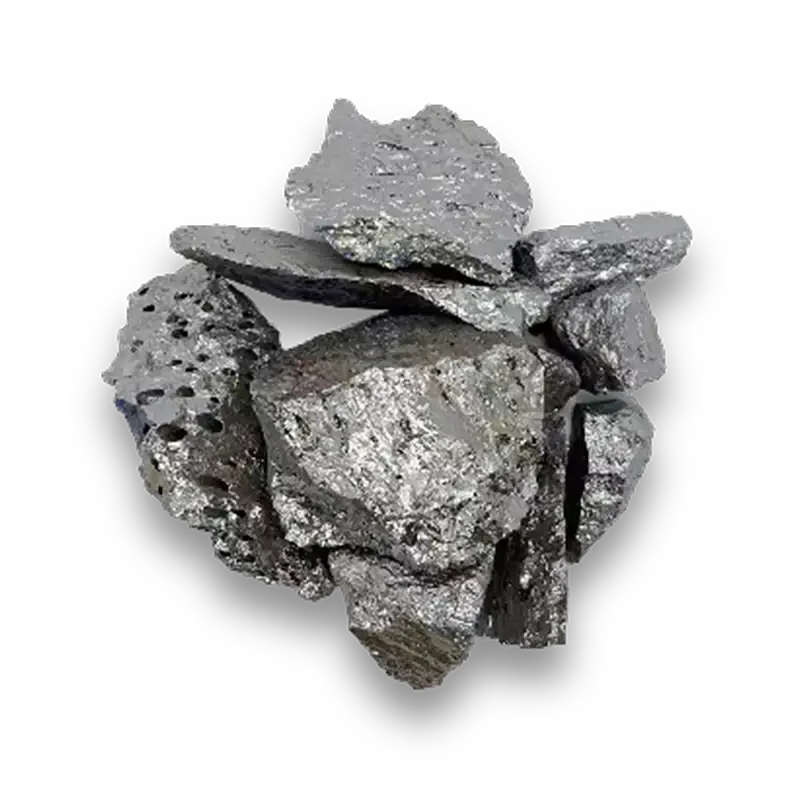
Silicon Metal is a product obtained by reducing quartz sand (mainly composed of SiO₂) with carbon at high temperatures. Its silicon content usually ranges from 98.5% to 99.8%.
- Physical: Gray-black solid with metallic luster at room temperature; high melting point (~1410°C), hard and brittle, cannot be forged or stretched like metals.
- Chemical: Stable at room temperature (no reaction with air/water); reacts with oxygen/chlorine at high temperatures to form SiO₂ or SiCl₄ (critical for further processing).
- Electrical: Has semiconductor properties but weak conductivity due to impurities; needs purification (over 99.9999%) for electronics use.
Applications
- Metallurgy: Added to aluminum/magnesium alloys to boost strength, hardness and wear resistance (used in auto parts, aerospace materials).
- Chemistry: Converted to organosilicon (silicone rubber, oil) or polysilicon (core material for photovoltaics, semiconductors).
- Electronics: High-purity silicon (electronic-grade) is made into wafers for chips, diodes and transistors.
Specifications
| Grades | Chemical Composition(%) | ||||
| Si ≥ | Fe≤ | AI≤ | Ca≤ | P≤ | |
| 1101 | 99.79 | 0.1 | 0.1 | 0.01 | 0.004 |
| 2202 | 99.58 | 0.2 | 0.2 | 0.02 | 0.004 |
| 3303 | 99.37 | 0.3 | 0.3 | 0.03 | 0.005 |
| 441 | 99.1 | 0.4 | 0.4 | 0.1 | – |
| 553 | 98.7 | 0.5 | 0.5 | 0.3 | – |
| poly-Si | 99.99 | 0.15 | 0.15 | 0.01 | 30ppm |